Welcome to the Seven Seas Challenge.
This competition is open to everyone in IG. The aim is to have fun, exercise, and challenge yourself and your team-mates across Strava disciplines. Simply connect your Strava account to this website, create or join a team, and you will begin scoring points. These points are calculated automatically based on your distance, elevation gains (cycling, walking, running) and posting photos. There are prizes for individual and team performance.
1) Competition window and eligible activities
Only eligible events between 2026-03-01 00:00:00 and 2026-05-01 23:59:59 count.
For Strava activities to be eligible, the activity must include route evidence or photo evidence:
- Activities with GPS or route data count.
- Manual Strava entries count only if they include at least one photo.
- Activities with neither a route nor a photo do not count for the competition.
2) Disciplines and Strava tagging
2.1 Strava disciplines (5)
We track these 5 Strava disciplines:
- Running
- Walking / Hiking
- Cycling
- Rowing
- Swimming
2.2 Which Strava tags count for each discipline
3) Individual discipline score
Each discipline keeps its own individual ranking.
The easiest way to explain the system is:
- Build a raw effort score from distance and, where relevant, elevation gain.
- Apply the personal factor (age factor, plus the female bonus).
- Rank participants by the resulting discipline score.
How a result becomes a ranking score
The three-step flow:
1. Raw effort
Distance is the base.
Climb adds bonus only for Running, Walking, and Cycling.
raw score = distance + climb bonus
2. Personal factor
Multiply by the age factor.
Female participants receive an extra +0.2 on the factor.
discipline score = raw score x factor
3. Ranking result
Compare the final discipline scores.
Highest score takes the better rank.
higher discipline score = better rank
Team points come later from rank and discipline pool.
3.1 Step 1: Raw effort score
| Discipline | Raw effort score | Interpretation |
|---|---|---|
| Running | distance_km + (elevation_gain_m / 50) |
For every 100m of elevation, add 2km. |
| Walking / Hiking | distance_km + (elevation_gain_m / 100) |
For every 100m of elevation, add 1km. |
| Cycling | distance_km + (elevation_gain_m / 20) |
For every 100m of elevation, add 5km. |
| Rowing | distance_km |
No elevation bonus. |
| Swimming | distance_km |
No elevation bonus. |
- Running: For every 100m of elevation, add 2km.
- Walking: For every 100m of elevation, add 1km.
- Cycling: For every 100m of elevation, add 5km.
Here are a few worked examples of the raw effort score:
Worked examples of raw effort
The colored extension shows how much extra score comes from climb bonus.
Run
10 km run
base distance = 10.0
climb bonus = +0.0
raw score 10.0
Run
10 km run
base distance = 10.0
climb bonus = +8.0
raw score 18.0
Walk
12 km walk
base distance = 12.0
climb bonus = +3.0
raw score 15.0
Ride
60 km ride
base distance = 60.0
climb bonus = +50.0
raw score 110.0
3.2 Step 2: Apply the personal factor
For Strava disciplines, the discipline score is:
The personal factor is the existing age factor, and female participants receive +0.2 on top.
Age is evaluated at the start of the competition (2026-03-01 00:00:00).
| Age range | Age factor | Female (+0.2) |
|---|---|---|
| < 30 | 1.0 | 1.2 |
| 30-39 | 1.2 | 1.4 |
| 40-44 | 1.4 | 1.6 |
| 45-49 | 1.6 | 1.8 |
| 50-54 | 1.8 | 2.0 |
| 55-59 | 2.0 | 2.2 |
| 60-64 | 2.2 | 2.4 |
| >= 65 | 2.5 | 2.7 |
3.3 Step 3: Build the individual ranking
- The individual discipline winner is the participant with the highest final discipline score in that discipline.
- If two participants have the same final score, the participant who reached that score first wins the tie.
4) Team ranking by discipline points
The big prize is based on the team ranking.
Teams must have 3 to 5 people.
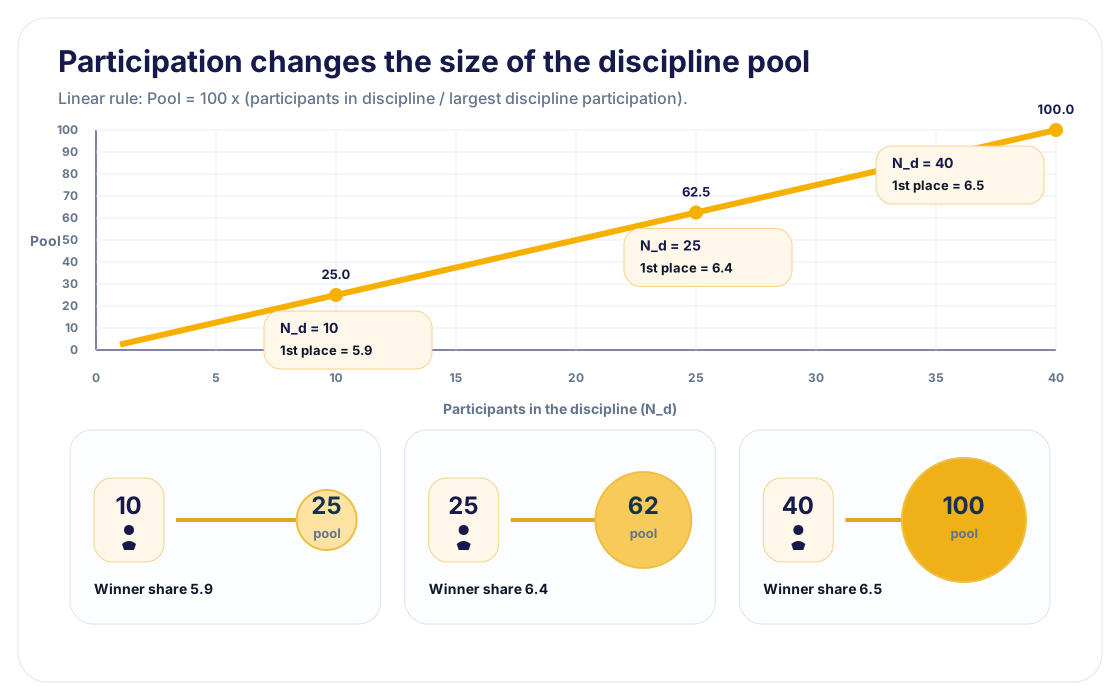
4.1 Step 1: Scale the discipline points pool by participation
Then the points pool for discipline is:
4.2 Step 2: Distribute the pool by rank
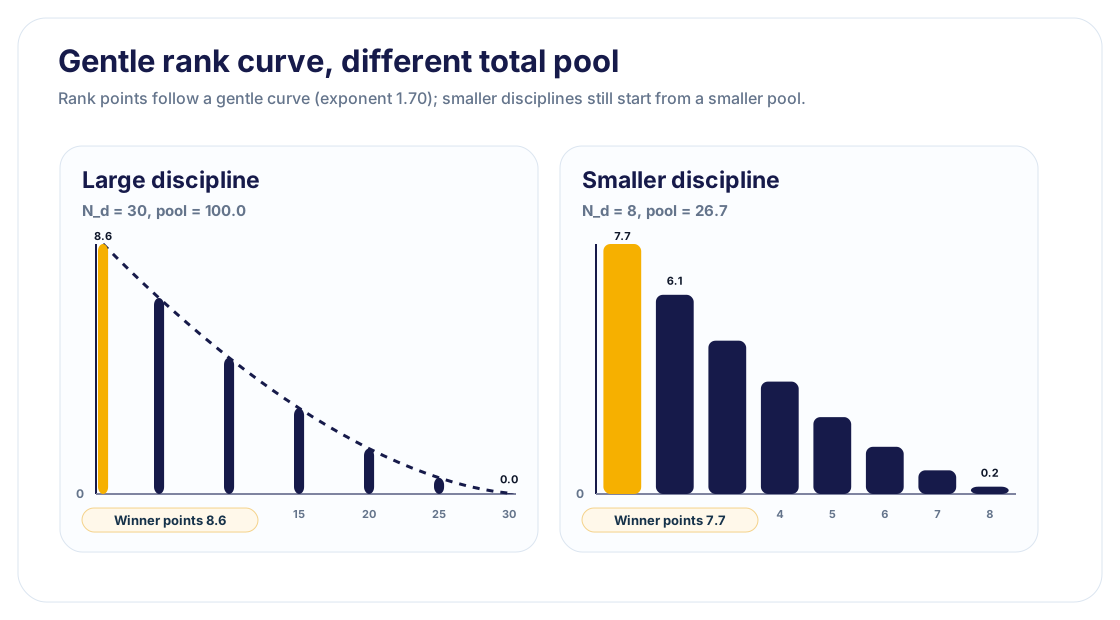
After the discipline pool is fixed, rank points decrease with a gentle curve from 1st place to the last participant.
4.3 Team score
5) Extra points
Extra points are earned by sharing photos (WhatsApp) or adding a photo to your Strava activity:
- 10 points for a photo of the whole team doing the activity (max 2 times).
- 5 points for a photo with at least 2 team members (max 4 times).
- 1 point for an individual photo (max 4 times per team member, added manually by admins).
- A single photo/activity cannot count for both categories.
- After the 2 full-team photos are used, additional full-team photos can count in the "at least 2 members" category (if that category still has capacity).
These are validated by the organizers. They do not change the individual discipline rankings. They only add points to the team overall ranking.
6) Tie-breaker
If two participants have the same score in a ranking table, the participant who reached the score first wins the tie.
7) Prizes
Overall Team Prize
The winning team takes the headline award
The overall winning team will receive a prestigious trophy and a Theragun Prime massage gun each.
Individual discipline prizes
Top three in each discipline receive vouchers.
Cycling
- 1st£200 Rapha voucher
- 2nd£100 Rapha voucher
- 3rd£50 Rapha voucher
Running
- 1st£200 Asics voucher
- 2nd£100 Asics voucher
- 3rd£50 Asics voucher
Walking
- 1st£200 The North Face voucher
- 2nd£100 The North Face voucher
- 3rd£50 The North Face voucher
Rowing
- 1st£200 Nike voucher
- 2nd£100 Nike voucher
- 3rd£50 Nike voucher
Swimming
- 1st£200 Speedo voucher
- 2nd£100 Speedo voucher
- 3rd£50 Speedo voucher
Weekly participation reward
All participants who exercise at least once a week will get a beautiful IG branded T-shirt, foldable water bottle and cooling towel.
Tax gross-up by IG
To ensure winners enjoy the full value of their awards, IG will "gross up" these prizes. This means IG will pre-pay any local income tax or social security contributions associated with this gift on prize winners' behalf.